RoadAtthena | Next-Generation:Road Asset management System
Insight
Next-Generation:Road Asset management System
March 9, 2026
India’s vast and heterogeneous roadway infrastructure—spanning National Highways, State Highways, urban corridors, rural link roads, bridges, and subgrade structures—demands an advanced, digitally enabled platform for systematic condition assessment, lifecycle maintenance, and asset performance management. An AI-Based Road Asset Management System (AI-RAMS) delivers an automated, scalable, and GIS-integrated framework that leverages computer vision–driven defect detection, high-resolution roadway imaging, big-data analytics, and intelligent sensor networks to support evidence-based monitoring and maintenance of the nation’s road assets.
Multi-Modal Data Capture System for Roads
The AI-Based Road Asset Management System begins with multi-modal data acquisition through vehicle-mounted multi-spectral cameras, Light Detection and Ranging (LiDAR) scanners, Unmanned Aerial Vehicle (UAV)–based imaging, mobile survey applications, and Internet of Things (IoT)–enabled pavement and bridge instrumentation. All collected telemetry is synchronized using Global Navigation Satellite System (GNSS), Real-Time Kinematic Global Positioning System (RTK-GPS), and dynamic chainage mapping to produce a highly detailed, geo-referenced digital asset inventory.
Road Surface Evaluation via Deep-Learning
Road Surface Evaluation via Deep-Learning
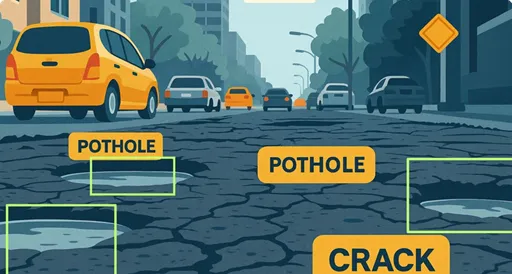
The acquired imagery and sensor telemetry are processed through advanced deep-learning pipelines, including convolutional neural networks and segmentation architectures. These AI models interpret and classify pavement distresses with precision, identifying defects such as potholes, longitudinal and transverse cracking, rutting, surface ravelling, edge failures, and shoulder depressions at pixel-level resolution.
Quantitative Performance Metrics
These can be calculated using standardized indices like Road Condition Index (RCI) and Pavement Condition Index (PCI). These indices synthesize parameters—fracture density, rut depth, severity gradation, International Roughness Index (IRI).
Predictive Road Asset Model Framework
By utilizing time-based datasets, environmental influence variables, traffic load assessments, and seasonal impact factors, the AI-Based Road Asset Management System employs forecasting neural networks and deterioration models to estimate upcoming asset performance trends. This analytical framework shifts maintenance strategies from reactive responses to forward-looking planning, reducing unexpected breakdowns, improving long-term budget utilization, and extending overall infrastructure service longevity.
GIS-based Operations
The operations hub utilizes a Geographic Information System–enabled interface where asset and defect metadata are displayed on detailed, spatially-referenced maps. Multi-layered chainage navigation allows users to cross-verify imagery, traffic load profiles, and weather-related patterns to support root-cause analysis. Automated documentation tools generate technical summaries, incident records, and maintenance work plans, all aligned with Indian Roads Congress (IRC) and Ministry of Road Transport and Highways (MoRTH) guidelines.
AI-RAMS offers a robust, scientific apparatus to sustain pervasive, quality-assured, and safe roadways.